5-20 Amplifier 20W
Mullard Wireless, London (see also Mullard Radio Valve)
- Produttore / Marca
- Mullard Wireless, London (see also Mullard Radio Valve)
- Anno
- 1955
- Categoria
- Kit, scatola di montaggio (parti sfuse e istruzioni o solo istruzioni di montaggio)
- Radiomuseum.org ID
- 283569


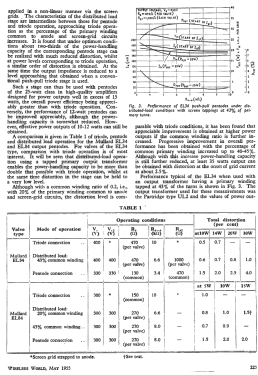


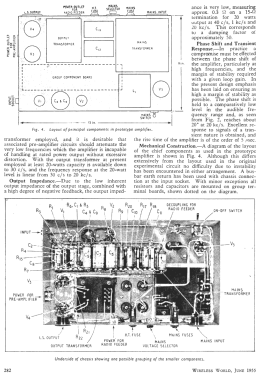

From manufactures document.
Clicca sulla miniatura dello schema per richiederlo come documento gratuito.
- Numero di tubi
- 5
- Principio generale
- Amplificatore audio
- Gamme d'onda
- - senza
- Tensioni di funzionamento
- Alimentazione a corrente alternata (CA) / 200-250 Volt
- Altoparlante
- - Questo apparecchio richiede altoparlante/i esterno/i.
- Potenza d'uscita
- 20 W (indistorta)
- Materiali
- Mobile di metallo
- Radiomuseum.org
- Modello: 5-20 Amplifier 20W - Mullard Wireless, London see
- Forma
- Chassis o in scatola da montaggio
- Annotazioni
-
The Mullard 5‑20 is a high‑fidelity 20‑watt reference amplifier design published in 1955 and demonstrated publicly at the National Radio Show that year. Developed around Mullard’s EF86, ECC83, EL34 and GZ34 valves, the circuit was presented in Wireless World (May and June 1955) by W. A. Ferguson as part of a detailed examination of output‑stage behaviour, transformer requirements, and feedback stability for high‑quality audio reproduction. Mullard subsequently issued the design in their Circuits for Audio Amplifiers series, where it became one of the most widely constructed British valve amplifiers of the 1950s.
Ferguson’s analysis compared triode, pentode and distributed‑load (ultralinear) operation of EL34 output valves, concluding that a 20–25% screen‑grid tapping offered the best compromise of linearity, efficiency and power reserve. The published 5‑20 circuit adopts this distributed‑load configuration, driven by an ECC83 cathode‑coupled phase splitter and preceded by an EF86 low‑noise pentode. With approximately 30 dB of global negative feedback applied from the output transformer secondary to the EF86 cathode, the amplifier achieves distortion and bandwidth performance comparable to Williamson‑type triode amplifiers while providing greater output power and improved transient behaviour.
The 5‑20 was intended as a constructional design rather than a factory‑built product. Numerous kit suppliers, educational institutions and hobby constructors adopted the circuit, and Mullard provided full wiring layouts, tag‑board diagrams, transformer specifications and measured performance curves.
Technical Description
The amplifier follows a three‑stage topology optimised for low distortion, wide bandwidth and stable feedback operation:- Input stage: EF86 operated as a low‑noise pentode voltage amplifier, chosen for high gain, good hum rejection and predictable characteristics.
- Phase splitter: ECC83 configured as a cathode‑coupled (long‑tailed‑pair) phase inverter, providing balanced drive to the output valves with low distortion and high common‑mode rejection.
- Output stage: Two EL34 pentodes in push‑pull, operated under distributed‑load (ultralinear) conditions with screen‑grid taps at approximately 20–25% of the primary turns. This configuration reduces third‑harmonic distortion and improves damping factor without the efficiency loss of full triode connection.
- Power supply: GZ34 indirectly‑heated full‑wave rectifier feeding a capacitor‑input filter. Mullard recommended a shared HT supply for ancillary preamplifier stages where required.
- Feedback network: Around 30 dB of global negative feedback applied from the secondary winding to the EF86 cathode, stabilised by phase‑compensation components determined experimentally to ensure margin at both low‑frequency transformer resonance and high‑frequency leakage‑inductance limits.
- Output transformer: Wide‑bandwidth, accurately balanced primary windings with low leakage inductance, essential for maintaining stability with high feedback. Ferguson’s Wireless World analysis emphasised transformer quality as the dominant factor in achieving the published performance.
The Mullard 5‑20 is the higher‑power development of the earlier 5‑10, using the same circuit principles but scaled to a 20‑watt EL34 output stage.
- Bibliografia
- Wireless World (The), London (WW, 79) (May 1955, p.223-227)
- Letteratura / Schemi (1)
- Wireless World (The), London (WW, 79) (Jun 1955, p.279-282)
- Autore
- Modello inviato da Gary Cowans. Utilizzare "Proponi modifica" per inviare ulteriori dati.
- Altri modelli
-
In questo link sono elencati 151 modelli, di cui 121 con immagini e 65 con schemi.
Elenco delle radio e altri apparecchi della Mullard Wireless, London (see also Mullard Radio Valve)